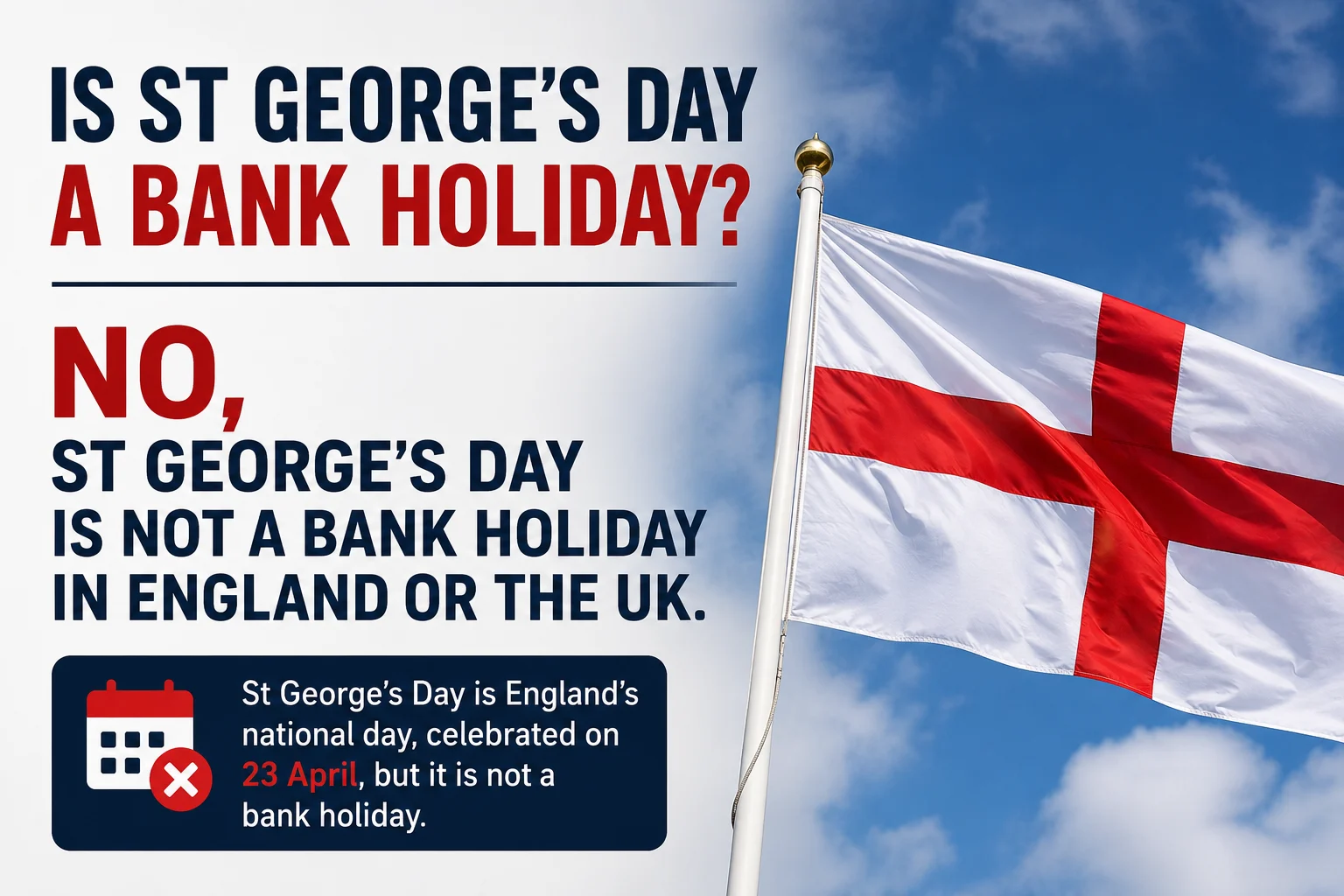
Many people ask, is St Georges Day a bank holiday in England? Since St George is England’s patron saint and the day is widely celebrated across the country, it’s a reasonable question. Every year on April 23, communities mark the occasion with parades, festivals, church services, and displays of the famous red-and-white St George’s Cross.
- Quick Facts Table
- Is St Georges Day a Bank Holiday in England?
- What Is the Official Status of St George's Day?
- Why Do People Think It Might Be a Bank Holiday?
- What Happens on St George's Day?
- The History Behind St George's Day
- Who Was St George?
- How Did He Become England's Patron Saint?
- Was St George's Day Ever a Holiday?
- Why Isn't St George's Day a Bank Holiday?
- How Are Bank Holidays Created?
- Why England Doesn't Have a Patron Saint Bank Holiday
- Public Campaigns for Change
- St George's Day Compared With Other UK Patron Saint Days
- Scotland and St Andrew's Day
- Northern Ireland and St Patrick's Day
- Wales and St David's Day
- Comparison Table: UK Patron Saint Days
- Modern Celebrations and Cultural Importance
- Community Events Across England
- The Role of the St George's Cross
- Growing Interest in English Heritage
- Could St George's Day Become a Bank Holiday in the Future?
- Political Discussions
- Economic Considerations
- Public Support
- Did You Know?
- Key Takeaways
- Q: Is St George's Day a bank holiday in England?
- Q: Why isn't St George's Day a bank holiday?
- Q: Do people get a day off for St George's Day?
- Q: How is St George's Day celebrated?
- Q: Could St George's Day become a bank holiday in the future?
- Conclusion
However, despite its cultural importance, the answer often surprises people. St George’s Day is not treated the same way as some other national saint celebrations within the United Kingdom. In this guide, you’ll learn whether St George’s Day is a bank holiday, why it isn’t one, how the day is celebrated, and whether there are any chances it could become a public holiday in the future.
Quick Facts Table
| Topic | Details |
|---|---|
| Event Name | St George’s Day |
| Date | Usually April 23 |
| Patron Saint Of | England |
| Bank Holiday Status | No |
| Public Holiday Status | No |
| Main Purpose | Celebrating England’s patron saint |
| Typical Celebrations | Parades, church services, festivals, flag displays |
| Observed In | Primarily England |
| Historical Significance | Honors St George, England’s national saint |
| Related Topics | St Andrew’s Day, St Patrick’s Day, English traditions |
Is St Georges Day a Bank Holiday in England?
What Is the Official Status of St George’s Day?
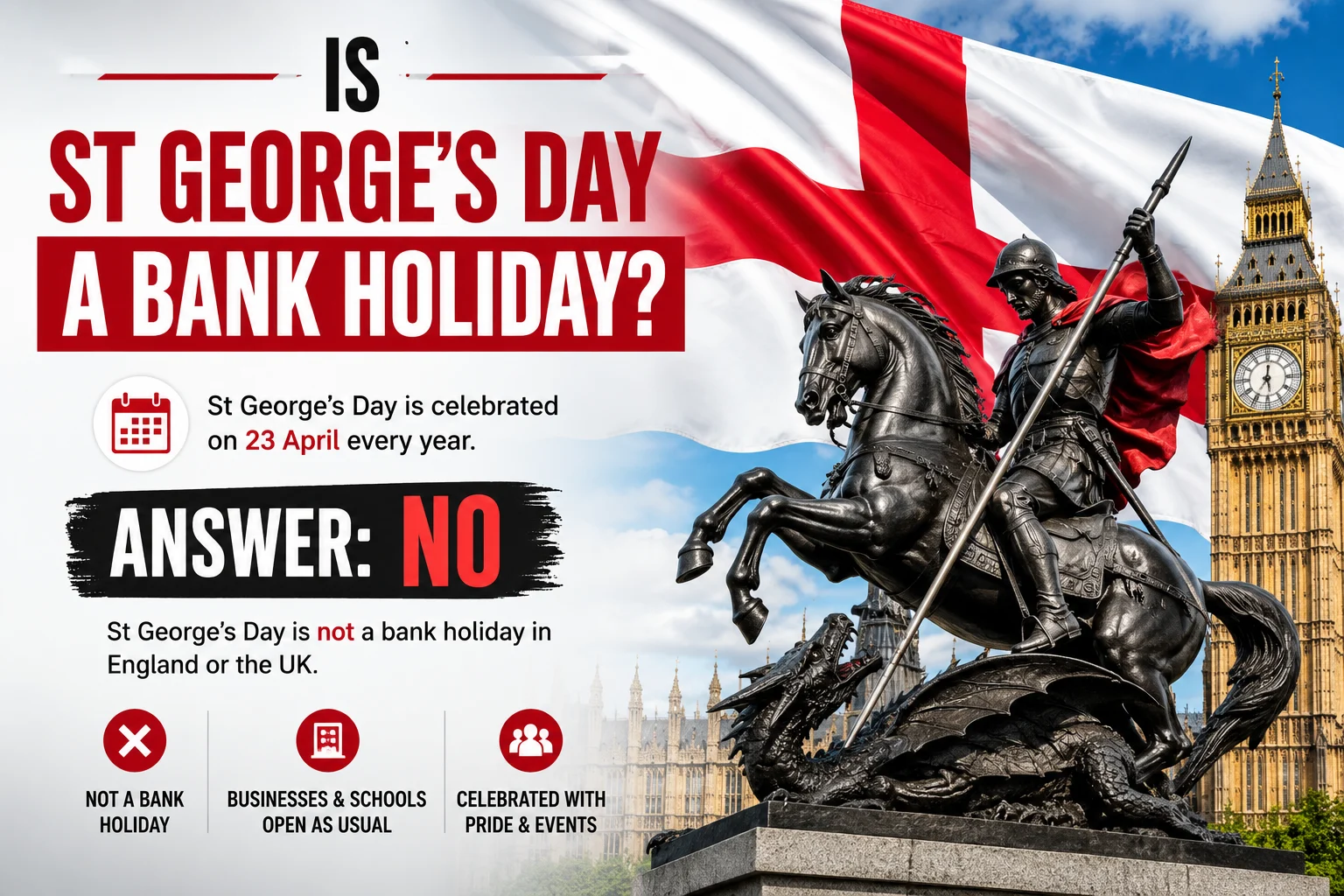
The straightforward answer is no. St George’s Day is not a bank holiday in England. Businesses, schools, government offices, shops, and public transport generally operate as normal on April 23.
Although many people celebrate the occasion, it is classified as a local observance rather than a public holiday. This means there is no automatic day off work or school for most people.
The distinction often causes confusion because England’s patron saint day carries significant national importance. Despite this, it does not appear on the official list of bank holidays observed across England and Wales.
Why Do People Think It Might Be a Bank Holiday?
One reason for the confusion is that other parts of the United Kingdom have bank holidays linked to their patron saints. Scotland celebrates St Andrew’s Day, while Northern Ireland recognizes St Patrick’s Day as a bank holiday.
Because England has its own patron saint, many assume St George’s Day receives similar treatment. In reality, it does not.
The widespread visibility of celebrations also contributes to the misunderstanding. Seeing flags, local events, and community gatherings can make the day feel like a national holiday even though normal business continues.
What Happens on St George’s Day?
While most people still work, many communities organize special events to celebrate English heritage and culture.
Common activities include:
- Local parades
- Traditional Morris dancing
- Church services
- Community festivals
- Flag-raising ceremonies
- Educational activities in schools
Many pubs, town centers, and civic buildings display the St George’s Cross throughout the day. Some towns host family-friendly events that attract thousands of visitors.
The History Behind St George’s Day
Who Was St George?
St George is believed to have been a Roman soldier and Christian martyr who lived during the third century. He became famous through legends describing his courage and commitment to his faith.
The most well-known story is the legend of St George and the Dragon. According to tradition, he defeated a dragon that was terrorizing a town and rescued a princess.
Although historians debate parts of the legend, St George became a symbol of bravery, honor, and sacrifice across Europe.
How Did He Become England’s Patron Saint?
St George’s association with England dates back centuries. During the Middle Ages, English soldiers adopted him as a symbol of courage and protection.
His popularity grew significantly during the reign of King Edward III, who established the prestigious Order of the Garter under St George’s patronage.
Over time, the red cross on a white background became closely linked with England itself. Today, it remains one of the most recognizable national symbols in the country.
Was St George’s Day Ever a Holiday?
Historically, St George’s Day enjoyed greater prominence than it does today. In earlier centuries, it was celebrated more formally and carried greater national significance.
As social and political changes occurred over time, the day gradually lost its status as a major national holiday. Other public holidays became more deeply established within the annual calendar.
Even so, campaigns to restore St George’s Day as a public holiday continue to appear periodically, reflecting ongoing public interest in the idea.
Why Isn’t St George’s Day a Bank Holiday?
How Are Bank Holidays Created?
Bank holidays in the United Kingdom are established through legislation or royal proclamation. New bank holidays can be introduced, but the process requires government support and official approval.
The government considers various factors before creating new holidays, including economic impact, public demand, and scheduling concerns.
Because of these considerations, adding a new permanent bank holiday is not always straightforward.
Why England Doesn’t Have a Patron Saint Bank Holiday
Unlike Scotland and Northern Ireland, England does not currently have a dedicated bank holiday linked to its patron saint.
One reason is that England already follows a set schedule of established bank holidays throughout the year. Introducing another national holiday would require broader political agreement.
Successive governments have generally chosen not to add an additional annual bank holiday specifically for St George’s Day.
Public Campaigns for Change
Over the years, several campaigns and petitions have called for St George’s Day to become an official bank holiday.
Supporters argue that:
- It would celebrate English identity.
- It would align England with other UK nations.
- It could boost tourism and local events.
- It would provide an additional day of rest for workers.
Critics often point to the economic costs associated with introducing another nationwide holiday. As a result, the debate continues without a permanent resolution.
St George’s Day Compared With Other UK Patron Saint Days
Scotland and St Andrew’s Day
Scotland celebrates St Andrew’s Day on November 30. It is officially recognized as a bank holiday in Scotland.
However, not everyone automatically receives the day off. Individual employers still determine workplace arrangements according to contracts and policies.
The holiday nevertheless gives Scotland a distinct national celebration linked directly to its patron saint.
Northern Ireland and St Patrick’s Day
St Patrick’s Day, celebrated on March 17, is a bank holiday in Northern Ireland.
The day features parades, cultural events, music, and community gatherings. It has become one of the most recognized patron saint celebrations worldwide.
Its official holiday status often leads people to question why England does not have a similar arrangement for St George’s Day.
Wales and St David’s Day
Interestingly, Wales faces a similar situation to England. St David’s Day is widely celebrated on March 1 but is not currently a bank holiday.
As with St George’s Day, there have been repeated calls to change this. However, no permanent national holiday has been established.
This means England and Wales both celebrate their patron saints without an official bank holiday.
Comparison Table: UK Patron Saint Days
| Nation | Patron Saint | Celebration Day | Bank Holiday? |
|---|---|---|---|
| England | St George | April 23 | No |
| Scotland | St Andrew | November 30 | Yes |
| Northern Ireland | St Patrick | March 17 | Yes |
| Wales | St David | March 1 | No |
Modern Celebrations and Cultural Importance
Community Events Across England
Many towns and cities host local events to mark the occasion. These celebrations often focus on English traditions, heritage, and community spirit.
Activities can include historical reenactments, music performances, and cultural exhibitions.
Families often attend local festivals where they can learn more about English history and customs.
The Role of the St George’s Cross
The St George’s Cross remains one of England’s most powerful symbols.
On April 23, flags appear on public buildings, sports venues, pubs, and private homes. The symbol is particularly prominent during major sporting events involving England.
For many people, displaying the flag is a simple way to express national pride and participate in the celebration.
Growing Interest in English Heritage
Recent years have seen renewed interest in local traditions and national identity. This has helped increase awareness of St George’s Day among younger generations.
Schools, museums, and community groups often organize educational activities to explore English history and culture.
If you’re interested in heritage celebrations, you may also enjoy a related guide to traditional English festivals or a complete tutorial on UK public holidays and observances.
Could St George’s Day Become a Bank Holiday in the Future?
Political Discussions
From time to time, politicians and public figures propose making St George’s Day a bank holiday.
These discussions often gain attention around April each year, especially when public interest in national celebrations rises.
However, proposals have not yet resulted in permanent changes to the official holiday calendar.
Economic Considerations
Supporters highlight potential tourism and hospitality benefits.
Opponents argue that additional bank holidays can create costs for businesses and public services. Policymakers must balance cultural benefits against economic considerations.
This balance is one reason why the issue remains under discussion rather than becoming law.
Public Support
Surveys and petitions regularly show that many people would welcome a St George’s Day bank holiday.
Support tends to increase during periods of heightened national pride, such as major sporting events or significant national anniversaries.
For now, though, St George’s Day remains a celebrated observance rather than a public holiday.
Did You Know?
💡 St George is also the patron saint of several other countries, including Georgia, Ethiopia, and Portugal.
💡 St George’s Day is normally observed on April 23, but the celebration date can occasionally be moved when it conflicts with Easter observances.
💡 The St George’s Cross later became one of the key elements incorporated into the Union Jack.
Key Takeaways
- St George’s Day is celebrated annually on April 23.
- The answer to is St George’s Day a bank holiday is currently no.
- England’s patron saint is St George.
- Businesses and schools usually operate normally on the day.
- Scotland and Northern Ireland have patron saint bank holidays, while England and Wales do not.
- Many communities celebrate through festivals, parades, and cultural events.
- Campaigns continue to advocate for official bank holiday status.
- The St George’s Cross remains a powerful symbol of English identity.
Q: Is St George’s Day a bank holiday in England?
A: No. St George’s Day is not a bank holiday in England. Most businesses, schools, government offices, and public services continue operating normally on April 23. The day is observed through celebrations and community events rather than an official public holiday.
Q: Why isn’t St George’s Day a bank holiday?
A: Although St George’s Day is England’s national day, the government has not designated it as a bank holiday. Concerns about economic impact and existing holiday schedules have contributed to the decision not to create a new annual public holiday.
Q: Do people get a day off for St George’s Day?
A: Generally, no. Most employees and students follow normal schedules. However, some organizations, schools, or local groups may organize special events or activities to mark the occasion.
Q: How is St George’s Day celebrated?
A: Celebrations often include parades, church services, community festivals, flag displays, Morris dancing, and educational events. Many towns use the day to promote local heritage and English culture.
Q: Could St George’s Day become a bank holiday in the future?
A: It is possible. There have been multiple campaigns and political proposals supporting the idea. However, no legislation has been passed to make St George’s Day a permanent bank holiday in England.
Conclusion
So, is St George’s Day a bank holiday? The answer remains no. Despite being England’s national day and an important celebration of English heritage, April 23 is not currently recognized as an official bank holiday. Most people continue with normal work and school schedules while participating in local events, cultural celebrations, and community activities.
The topic continues to generate discussion, especially when comparisons are made with St Andrew’s Day in Scotland and St Patrick’s Day in Northern Ireland. Whether future governments decide to change its status remains uncertain. For now, St George’s Day remains a meaningful observance that celebrates England’s history, traditions, and national identity without granting a nationwide day off.