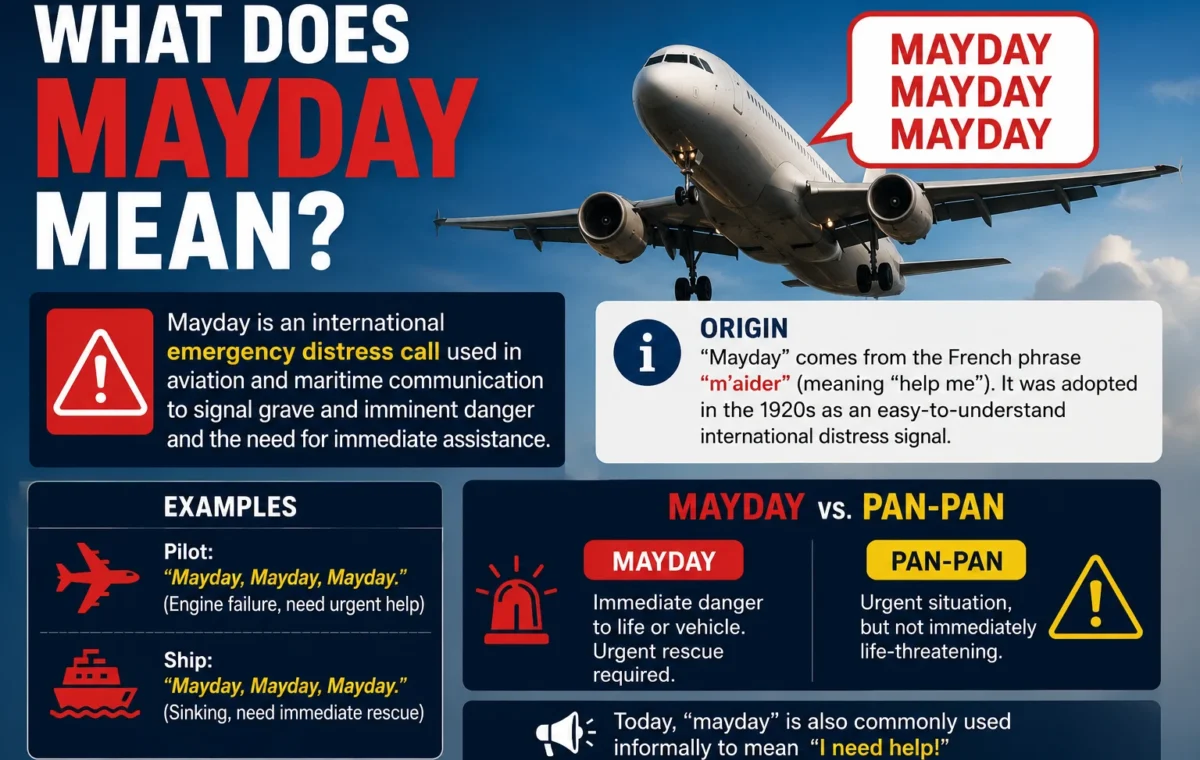
What does Mayday mean, and why is it used in life-threatening emergencies? In simple terms, Mayday is the internationally recognised distress call used by pilots, ship captains, and others facing a serious and immediate danger to life. When someone says “Mayday” three times over a radio, they’re signalling that urgent assistance is needed without delay.
- Quick Facts
- Table of Contents
- What Does Mayday Mean?
- The official meaning
- Why is it repeated three times?
- Who can declare Mayday?
- Where Did the Word Mayday Come From?
- A French-inspired emergency call
- Why was it introduced?
- Why it has stood the test of time
- When Is Mayday Used?
- Aircraft emergencies
- Maritime emergencies
- Search and rescue situations
- Mayday vs Pan-Pan
- Common Myths About Mayday
- Myth: Only pilots can say Mayday
- Myth: Saying Mayday automatically means disaster
- Myth: People get punished for declaring Mayday
- How a Mayday Call Is Made
- Step 1: Repeat "Mayday" three times
- Step 2: Identify yourself
- Step 3: Explain the emergency
- Why Mayday Is Still Important Today
- Global recognition
- Supports rapid rescue
- Still taught worldwide
- Did You Know?
- Key Takeaways
- FAQ
- Q: What does Mayday mean in aviation?
- Q: Why do pilots say Mayday three times?
- Q: Is Mayday only used by aircraft?
- Q: What is the difference between Mayday and SOS?
- Q: Can someone be punished for using Mayday?
- Why Understanding What Does Mayday Mean Matters
Although many people hear the word in films or news reports, few know where it came from, why it’s repeated three times, or how it differs from other emergency calls such as “Pan-Pan.” This guide explains the history, meaning, proper use, and common misconceptions surrounding Mayday while exploring why it remains one of the world’s most important emergency signals.For more insights read here:- best ramen bowls and faith brown.
Quick Facts
| Fact | Details |
|---|---|
| Meaning | International distress signal for grave and imminent danger |
| Used By | Aviation, maritime, and some emergency rescue services |
| Spoken As | “Mayday, Mayday, Mayday” |
| Origin | Derived from the French phrase m’aider (“help me”) |
| Introduced | During the early 1920s |
| Purpose | Request immediate emergency assistance |
| Radio Priority | Highest priority distress communication |
Table of Contents
- What Does Mayday Mean?
- Where Did the Word Mayday Come From?
- When Is Mayday Used?
- Mayday vs Pan-Pan
- Common Myths About Mayday
What Does Mayday Mean?
The official meaning
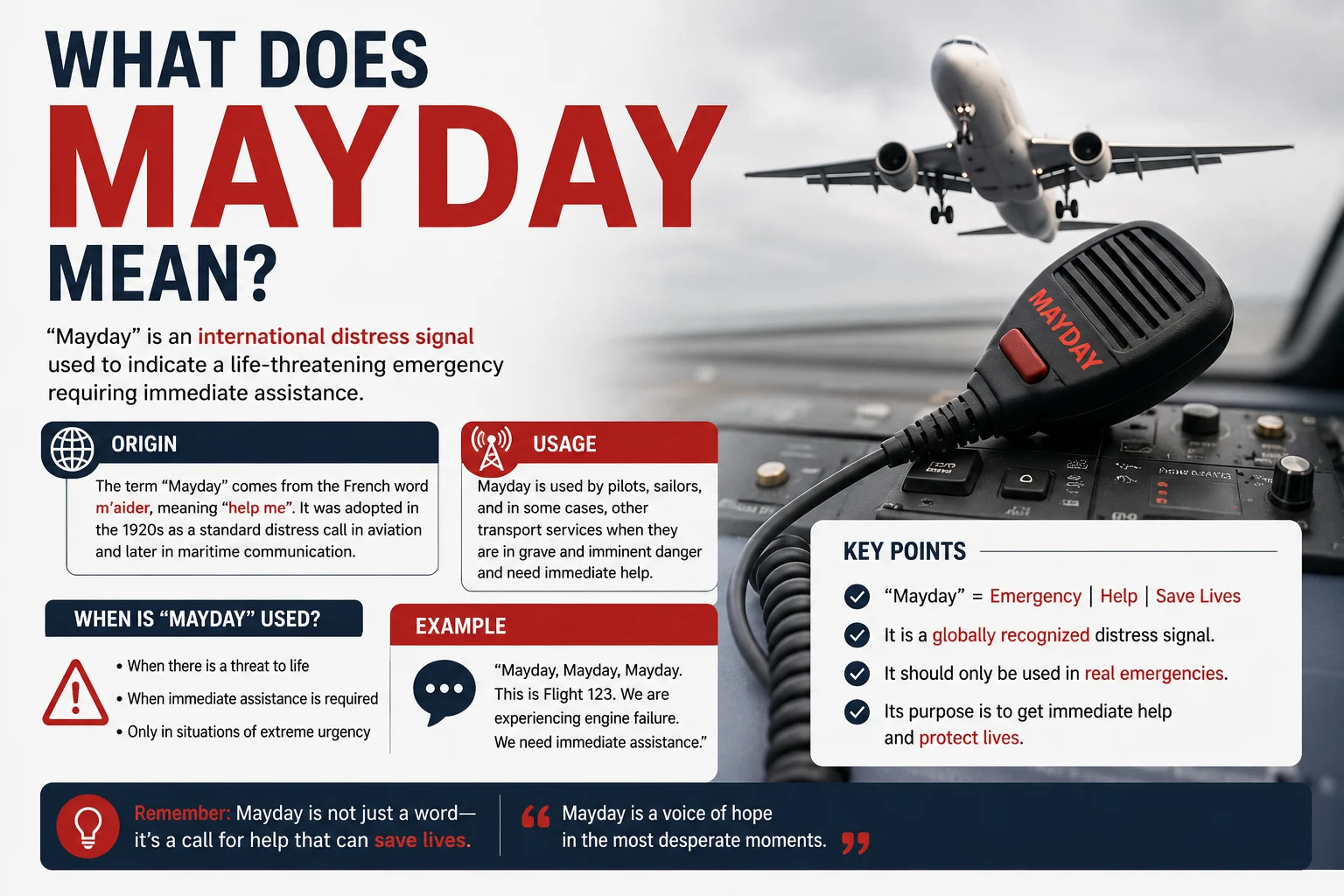
Mayday is the international voice distress signal used when a person, aircraft, or vessel is in grave and imminent danger and requires immediate help. It is recognised worldwide and has priority over all other radio communications.Also explore:- merlin griffiths.
The signal is accepted under international aviation and maritime communication rules, allowing emergency responders to quickly identify situations where lives may be at risk.
Why is it repeated three times?
A distress call is spoken as:
“Mayday, Mayday, Mayday.”
Repeating the word three times helps reduce misunderstanding caused by radio interference, poor signal quality, or background noise. It also makes it immediately clear that the transmission is an emergency rather than part of an ordinary conversation.
This standard format has been used for decades and is recognised internationally.
Who can declare Mayday?
Although airline pilots and ship captains are the people most commonly associated with Mayday, anyone operating an appropriate emergency radio may use it if there is an immediate threat to life.
Examples include:
- Aircraft pilots
- Helicopter crews
- Ship captains
- Coastguard rescue units
- Emergency rescue teams
The priority is always saving lives rather than worrying about formal procedures.
Where Did the Word Mayday Come From?
A French-inspired emergency call
The word “Mayday” does not come from the month of May.
Instead, it comes from the French expression “m’aider”, meaning “help me.” The pronunciation sounded clear and distinctive over early radio equipment.
Because aviation increasingly connected Britain and France during the early twentieth century, a word easily understood by both English and French speakers became especially useful.
Why was it introduced?
Before Mayday became standard, different emergency phrases were used, leading to confusion.
A clear international distress signal allowed air traffic controllers and rescue operators to recognise emergencies immediately, regardless of nationality.
This consistency remains essential today because aviation and shipping involve people from many countries.
Why it has stood the test of time
Modern communication technology has advanced enormously, but voice radio remains an important backup during emergencies.
Even with satellite systems and digital tracking, pilots and mariners continue to train using Mayday because it is universally recognised and requires no special equipment beyond radio communication.
When Is Mayday Used?
Aircraft emergencies
Pilots declare Mayday only for genuine emergencies involving immediate danger.
Examples include:
- Engine failure
- Fire onboard
- Loss of aircraft control
- Severe structural damage
- Medical emergencies threatening life
- Emergency landings
Air traffic control immediately gives priority to the aircraft in distress.
Maritime emergencies
Ships also use Mayday during situations such as:
- Sinking vessels
- Serious onboard fires
- Collision damage
- Flooding
- Crew abandoning ship
Coastguard agencies coordinate rescue operations once a valid distress call is received.
Search and rescue situations
Emergency helicopters and rescue services may also relay or respond to Mayday calls when coordinating lifesaving operations.
Fast communication allows nearby aircraft, ships, and rescue authorities to assist as quickly as possible.
Mayday vs Pan-Pan
People often confuse Mayday with another radio signal called Pan-Pan.
While both indicate emergencies, they represent different levels of urgency.
| Mayday | Pan-Pan |
|---|---|
| Immediate danger to life | Urgent situation but not immediately life-threatening |
| Highest radio priority | Lower priority than Mayday |
| Immediate rescue often required | Assistance may be needed but situation remains under control |
| Used for severe emergencies | Used for urgent operational issues or medical concerns |
For example, an aircraft with a fire onboard would normally declare Mayday, while an aircraft experiencing a non-critical equipment problem might issue a Pan-Pan call instead.
Understanding this distinction helps emergency services prioritise resources effectively.
Common Myths About Mayday
Myth: Only pilots can say Mayday
This is false.
Anyone responsible for a vessel or aircraft facing immediate danger may transmit Mayday if emergency communication equipment is available.
The signal exists to save lives rather than restrict who can request help.
Myth: Saying Mayday automatically means disaster
Not necessarily.
Many Mayday situations end safely because emergency procedures are well rehearsed.
Declaring Mayday early often gives emergency responders more time to prepare assistance and improve the outcome.
Myth: People get punished for declaring Mayday
Emergency authorities encourage people to declare Mayday whenever a genuine life-threatening emergency exists.
Using it appropriately is considered responsible.
However, intentionally making false distress calls is illegal in many countries because it wastes valuable rescue resources.
How a Mayday Call Is Made
Step 1: Repeat “Mayday” three times
The caller begins with:
“Mayday, Mayday, Mayday.”
This instantly identifies the transmission as the highest-priority distress message.
Step 2: Identify yourself
The operator states:
- Aircraft or vessel name
- Call sign if applicable
This helps emergency responders identify exactly who requires assistance.
Step 3: Explain the emergency
Important details include:
- Nature of the emergency
- Current location
- Number of people onboard
- Assistance required
- Any other relevant information
Keeping information clear and calm helps rescue teams respond effectively.
Why Mayday Is Still Important Today
Global recognition
Whether flying across continents or sailing international waters, Mayday is understood almost everywhere.
This universal recognition removes language barriers during emergencies.
Supports rapid rescue
Every second counts during life-threatening situations.
Because Mayday immediately signals maximum urgency, rescue agencies can begin coordinating resources without delay.
Still taught worldwide
Pilots, maritime officers, coastguards, and emergency personnel continue to receive training on proper Mayday procedures.
Even as technology evolves, the voice distress call remains an essential safety standard.
You may also enjoy reading our guides on aviation safety terms, common emergency communication signals, and how air traffic control works.
Did You Know?
- Mayday is recognised internationally regardless of the speaker’s native language.
- The word has been used in aviation and maritime communication for around a century.
- Digital emergency systems now complement Mayday, but they have not replaced the spoken distress call.
Key Takeaways
- What does Mayday mean? It is the highest international distress signal for immediate danger.
- The word comes from the French phrase m’aider, meaning “help me.”
- Mayday is repeated three times to avoid confusion over radio communications.
- Pilots, ship captains, and rescue operators commonly use the signal.
- Mayday and Pan-Pan are different emergency calls with different urgency levels.
- Declaring Mayday early can improve rescue coordination.
- False Mayday calls are taken seriously because they divert emergency resources.
- The signal remains a vital part of modern aviation and maritime safety.
FAQ
Q: What does Mayday mean in aviation?
A: In aviation, Mayday is the internationally recognised distress call used when an aircraft faces grave and imminent danger. It tells air traffic control that immediate assistance and priority handling are required to protect lives.
Q: Why do pilots say Mayday three times?
A: Pilots repeat Mayday three times to ensure the distress signal is clearly understood despite radio interference or poor transmission quality. Repetition reduces the risk of misunderstanding during a critical emergency.
Q: Is Mayday only used by aircraft?
A: No. Ships, coastguard services, and other rescue organisations also use Mayday. It is the standard international voice distress signal across both aviation and maritime operations whenever lives are in immediate danger.
Q: What is the difference between Mayday and SOS?
A: SOS was originally a Morse code distress signal, while Mayday is a spoken voice distress call used over radio communications. Both indicate serious emergencies, but they were designed for different communication methods.
Q: Can someone be punished for using Mayday?
A: A genuine Mayday call is encouraged whenever there is an immediate threat to life. However, deliberately making a false distress call can result in serious legal consequences because it wastes emergency resources and may delay help for real emergencies.
Why Understanding What Does Mayday Mean Matters
Knowing what does Mayday mean is more than learning an interesting aviation term. It helps explain how emergency services communicate quickly and efficiently when lives are at risk. The signal has remained virtually unchanged for decades because it is simple, internationally recognised, and highly effective. Whether you hear it in an aircraft emergency, a maritime rescue, or a news report, Mayday always indicates the highest level of urgency. Understanding its purpose also highlights the importance of clear communication during crises and the role this single word continues to play in protecting lives around the world.