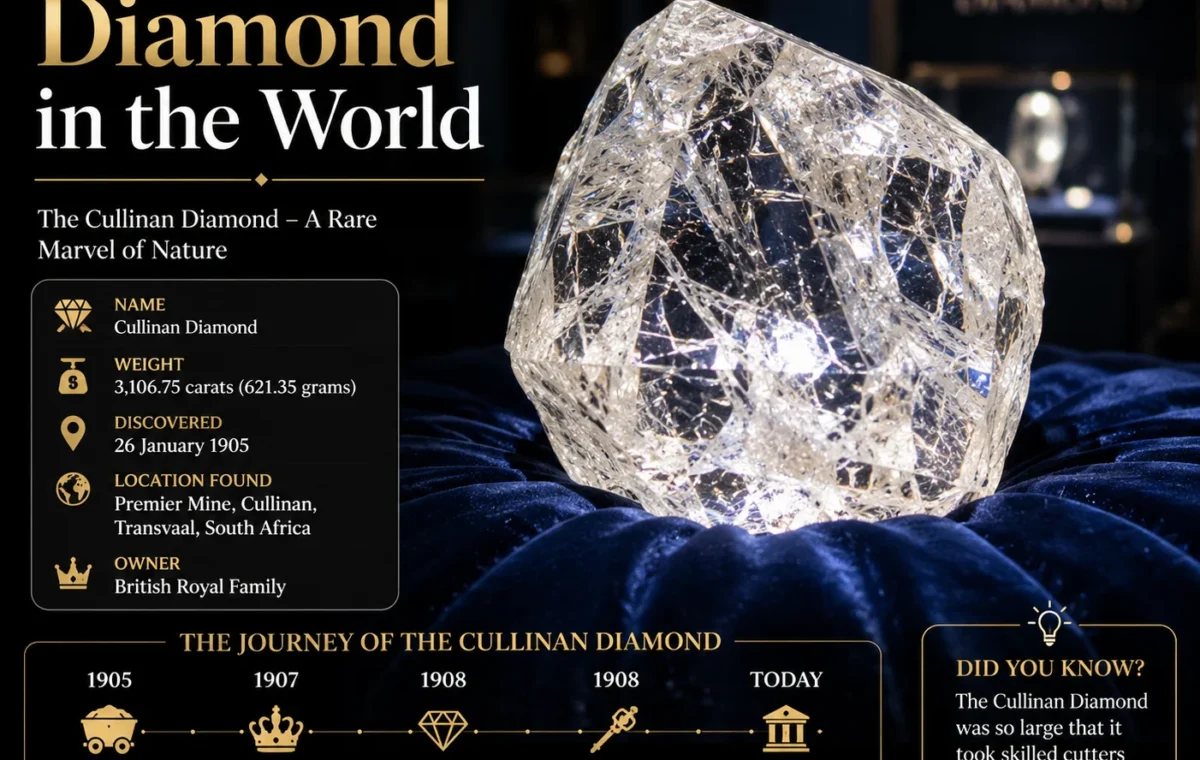
The biggest diamond in the world ever discovered is the Cullinan Diamond, a remarkable gemstone that changed the history of diamonds forever. Unearthed in South Africa in 1905, the rough stone weighed an astonishing 3,106.75 carats (621.35 grams), making it the largest gem-quality rough diamond ever found.
- Table of Contents
- What Is the Biggest Diamond in the World?
- The record-breaking Cullinan Diamond
- Why size alone doesn't determine value
- What does "carat" actually mean?
- The Discovery of the Cullinan Diamond
- An accidental but historic find
- Named after Sir Thomas Cullinan
- A gift with royal significance
- How the Cullinan Diamond Was Cut
- A highly skilled operation
- Nine major diamonds emerged
- Where are they today?
- Other Famous Giant Diamonds
- Golden Jubilee Diamond
- Lesedi La Rona
- Excelsior Diamond
- Comparison Table: Largest Famous Rough Diamonds
- Why the Cullinan Diamond Is So Valuable
- Extraordinary rarity
- Historical importance
- Lasting influence on jewellery
- Could an Even Bigger Diamond Be Found?
- It's possible—but unlikely
- New discoveries still happen
- Future mining may reveal surprises
- Did You Know?
- Key Takeaways
- Q: What is the biggest diamond in the world?
- Q: Where was the Cullinan Diamond found?
- Q: Is the Cullinan Diamond still one piece?
- Q: Has any diamond ever been bigger than the Cullinan?
- Q: Why is the biggest diamond in the world so famous?
- The Enduring Legacy of the Biggest Diamond in the World
For more than a century, the Cullinan Diamond has fascinated historians, gem experts, collectors, and jewellery enthusiasts alike. In this guide, you’ll discover how it was found, why it’s so valuable, what happened after it was cut, and how it compares with other famous diamonds. We’ll also explore whether a larger diamond could ever be discovered in the future.For more insights read here:- robin smith and peaches geldof.
| Quick Facts | Details |
|---|---|
| Largest rough diamond | Cullinan Diamond |
| Weight | 3,106.75 carats (621.35 g) |
| Discovery date | 26 January 1905 |
| Discovery location | Premier Mine, South Africa |
| Named after | Sir Thomas Cullinan |
| Diamond type | Gem-quality rough diamond |
| Largest polished stone | Great Star of Africa (Cullinan I) |
| Current significance | Historic royal diamond collection |
Table of Contents
- What Is the Biggest Diamond in the World?
- The Discovery of the Cullinan Diamond
- How the Cullinan Diamond Was Cut
- Other Famous Giant Diamonds
- Why the Cullinan Diamond Is So Valuable
- Could an Even Bigger Diamond Be Found?
What Is the Biggest Diamond in the World?
The record-breaking Cullinan Diamond
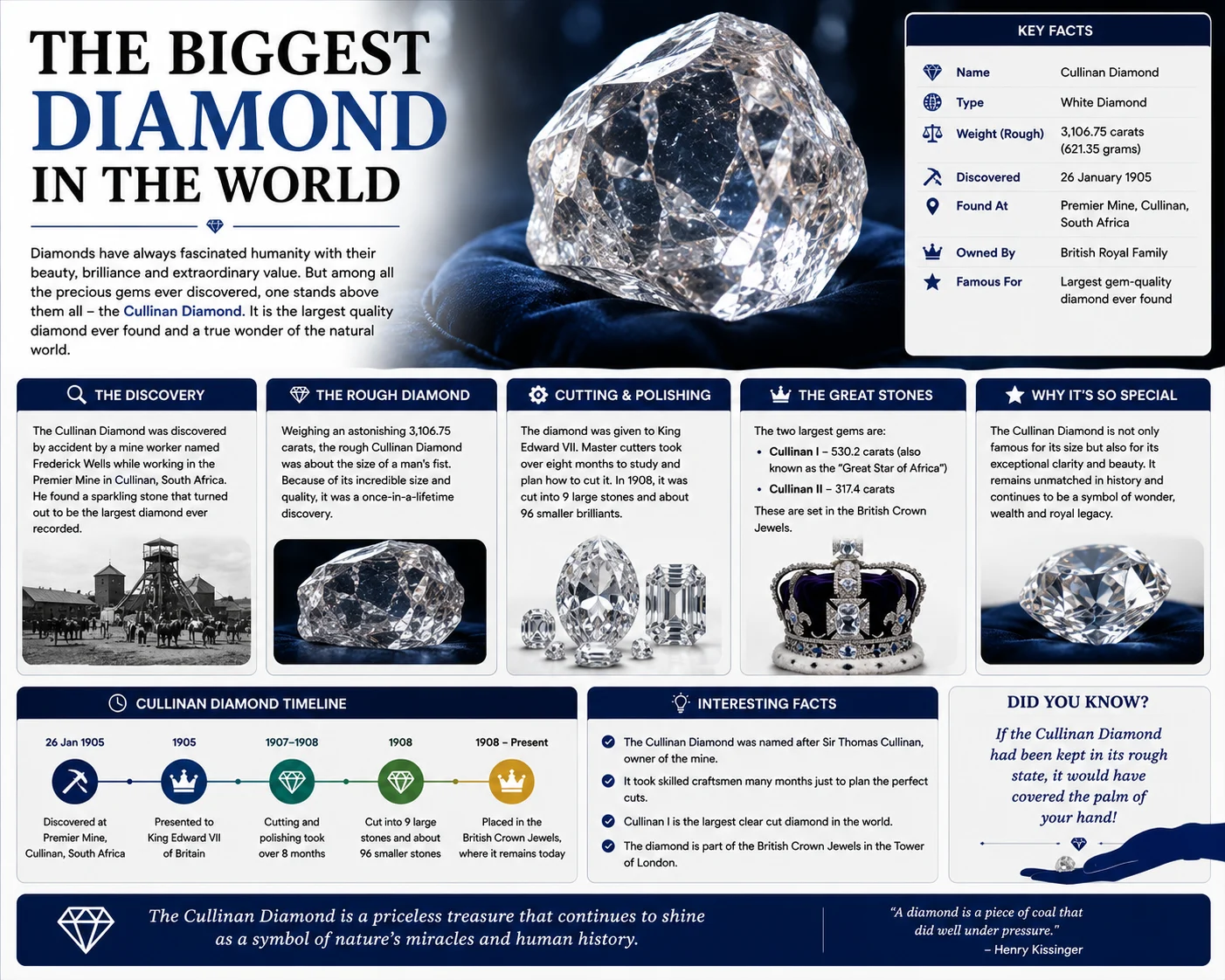
The Cullinan Diamond remains the largest gem-quality rough diamond ever discovered. It was found nearly two kilometres beneath the Earth’s surface at the Premier Mine near Pretoria, South Africa.
Its extraordinary clarity, colour, and size immediately made it one of the greatest geological discoveries in history. Although several enormous rough diamonds have been found since then, none has surpassed the Cullinan’s record weight.Also explore:- susannah constantine.
Why size alone doesn’t determine value
Many people assume the largest diamond must automatically be the most valuable. While size is important, gem experts also consider clarity, colour, cut, rarity, and historical significance.
A smaller flawless diamond can sometimes command a higher price per carat than a much larger stone with visible imperfections. The Cullinan is exceptional because it combined enormous size with outstanding quality.
What does “carat” actually mean?
Diamonds are measured in carats, not kilograms or ounces.
One carat equals 200 milligrams, meaning the Cullinan’s weight of 3,106.75 carats equals approximately 621 grams, or just over half a kilogram.
This standard measurement allows jewellers worldwide to compare gemstones accurately.
The Discovery of the Cullinan Diamond
An accidental but historic find
The remarkable stone was discovered on 26 January 1905 by mine superintendent Frederick Wells during a routine inspection of the Premier Mine.
He noticed something sparkling in the mine wall and retrieved what initially appeared to be a piece of glass. It soon became clear that the object was an enormous diamond unlike anything previously seen.
Named after Sir Thomas Cullinan
The stone received its name from Sir Thomas Cullinan, the owner of the mining company responsible for developing the Premier Mine.
His investment helped transform the mine into one of the world’s leading diamond producers, making the naming particularly fitting.
A gift with royal significance
A few years after its discovery, the diamond was presented to King Edward VII as a gesture celebrating relations within the British Empire.
Rather than keeping the stone intact, the decision was made to cut it into several polished diamonds that could be used in royal jewellery.
How the Cullinan Diamond Was Cut
A highly skilled operation
Cutting such a valuable stone required exceptional expertise. Dutch diamond cutter Joseph Asscher was chosen to undertake the delicate process.
Months were spent studying the crystal’s natural structure before the first cut was attempted. According to popular accounts, the first blade broke before the successful split was finally achieved.
Nine major diamonds emerged
Instead of producing one enormous polished gem, the rough stone yielded:
- Cullinan I (Great Star of Africa)
- Cullinan II
- Cullinan III
- Cullinan IV
- Cullinan V
- Cullinan VI
- Cullinan VII
- Cullinan VIII
- Cullinan IX
Numerous smaller diamonds were also produced during the cutting process.
Where are they today?
The largest polished stones remain closely associated with the British royal collection.
Cullinan I is traditionally mounted in the Sovereign’s Sceptre with Cross, while Cullinan II is set in the Imperial State Crown. Several other Cullinan diamonds have also appeared in royal jewellery over the years.
Other Famous Giant Diamonds
Golden Jubilee Diamond
Weighing 545.67 carats after polishing, the Golden Jubilee Diamond is the world’s largest faceted diamond.
Although its polished weight exceeds Cullinan I, it originated from a much smaller rough stone than the original Cullinan Diamond.
Lesedi La Rona
Discovered in Botswana in 2015, Lesedi La Rona weighed 1,109 carats in its rough form.
It ranks among the largest rough diamonds ever found but remains significantly smaller than the Cullinan.
Excelsior Diamond
Before the Cullinan discovery, the Excelsior Diamond held the world record.
Found in South Africa in 1893, it weighed 995.2 carats before being cut into multiple polished stones.
Comparison Table: Largest Famous Rough Diamonds
| Diamond | Rough Weight | Discovery Year | Country |
|---|---|---|---|
| Cullinan | 3,106.75 carats | 1905 | South Africa |
| Sewelo | 1,758 carats | 2019 | Botswana |
| Lesedi La Rona | 1,109 carats | 2015 | Botswana |
| Excelsior | 995.2 carats | 1893 | South Africa |
| Star of Sierra Leone | 968.9 carats | 1972 | Sierra Leone |
Why the Cullinan Diamond Is So Valuable
Extraordinary rarity
Gem-quality diamonds exceeding one thousand carats are exceptionally rare.
Finding a crystal over 3,000 carats with excellent transparency is considered one of the rarest geological events ever recorded.
Historical importance
The Cullinan Diamond is more than a gemstone.
Its connection to royalty, mining history, and gemstone craftsmanship has made it an enduring cultural symbol studied by historians and gemologists worldwide.
Lasting influence on jewellery
The Cullinan diamonds helped establish new standards for diamond cutting and gemstone preservation.
Even today, modern diamond cutters continue studying the techniques developed during the original cutting process.
You may also enjoy our guides on famous royal jewellery, most expensive gemstones, and rare precious stones.
Could an Even Bigger Diamond Be Found?
It’s possible—but unlikely
Geologists cannot completely rule out discovering an even larger gem-quality diamond.
Earth continues producing diamonds deep beneath its surface, and mining technology continues improving.
However, stones approaching the Cullinan’s size remain exceptionally uncommon.
New discoveries still happen
Recent decades have seen several impressive discoveries, particularly in Botswana.
Although these diamonds have attracted global attention, none has broken the Cullinan’s long-standing world record.
Future mining may reveal surprises
Advanced exploration methods may eventually uncover previously inaccessible diamond deposits.
Whether a future discovery surpasses the Cullinan remains unknown, but the possibility continues to excite scientists and gem enthusiasts alike.
Did You Know?
- The Cullinan Diamond was so large that some people initially believed it was part of an even bigger crystal.
- The Great Star of Africa (Cullinan I) remains one of the largest clear-cut colourless diamonds in the world.
- The Premier Mine where the Cullinan was discovered later became famous for producing several other exceptional diamonds.
Key Takeaways
- The biggest diamond in the world is the Cullinan Diamond.
- It weighed 3,106.75 carats in its rough form.
- The stone was discovered in South Africa in 1905.
- It was cut into nine major diamonds and many smaller gems.
- Cullinan I and Cullinan II remain among the most famous royal diamonds.
- No rough diamond has exceeded the Cullinan’s original size.
- Historical significance adds greatly to the diamond’s value.
- Modern mining continues searching for similarly extraordinary discoveries.
FAQ Section
Q: What is the biggest diamond in the world?
A: The biggest diamond in the world is the Cullinan Diamond, discovered in South Africa in 1905. It weighed 3,106.75 carats before being cut into several polished gemstones, including the famous Great Star of Africa.
Q: Where was the Cullinan Diamond found?
A: The Cullinan Diamond was discovered at the Premier Mine near Pretoria in South Africa. It was found by mine superintendent Frederick Wells during a routine inspection and quickly became one of history’s most celebrated gemstone discoveries.
Q: Is the Cullinan Diamond still one piece?
A: No. The original rough diamond was carefully divided into nine principal polished diamonds and many smaller stones. The largest pieces remain closely associated with the British royal collection.
Q: Has any diamond ever been bigger than the Cullinan?
A: No confirmed gem-quality rough diamond has exceeded the Cullinan Diamond’s weight of 3,106.75 carats. Several enormous diamonds have been discovered since, but none has surpassed this long-standing record.
Q: Why is the biggest diamond in the world so famous?
A: The Cullinan Diamond is famous because of its extraordinary size, exceptional quality, historical importance, and association with royal jewellery. It remains one of the most significant gemstone discoveries ever recorded.
The Enduring Legacy of the Biggest Diamond in the World
More than 120 years after its discovery, the biggest diamond in the world continues to capture the imagination of collectors, historians, and jewellery lovers alike. The Cullinan Diamond stands out not only because of its remarkable size but also because of its exceptional quality and lasting historical significance. Its transformation into several world-famous gemstones ensured its place in history, while its connection with royal regalia has kept public interest alive for generations. Although new giant diamonds continue to emerge, the Cullinan remains the benchmark against which every major discovery is measured, making it one of the greatest natural treasures ever uncovered.